
Early (Phase 1) Orthodontics: Expanders and Sagittal Correction
Phase 1 orthodontics is treatment carried out between roughly seven and ten years old, while the jaws are still growing. An expander widens a narrow upper jaw across; a sagittal appliance develops it forward. The purpose is to create room and correct the relationship between the upper and lower jaws before all the adult teeth arrive — which can reduce what later treatment is needed, and can avoid removing healthy adult teeth to make space.
- Ages
- About 7–10
- Duration
- 9–18 months
- Appliance
- Fixed or removable
- Fee
- S$872 – 2,180 per arch
What happens
Assessment with full records: photographs, a 3D scan, an OPG and where indicated a lateral cephalogram, plus a look at how the child breathes and whether the tonsils are obstructing.
A discussion of whether treating now is genuinely better than waiting. For some children the honest answer is to review in a year.
The appliance is fitted — a fixed expander cemented to the back teeth, or a removable plate, depending on what has to move.
Activation on a schedule, usually turned at home by a parent with a key, plus reviews every four to six weeks.
A retention period once the target width is reached, so new bone fills in and holds.
Reassessment when the adult teeth are through, to decide whether Phase 2 — braces or aligners — is needed at all.
Timing is the entire argument for treating early. The two halves of the upper jaw are joined by a suture that has not yet fused at this age, so widening the arch is a matter of gentle separation and new bone forming in the gap. Once that suture fuses in the teenage years, the same change requires surgery. A crossbite, a narrow arch with crowding, or an upper jaw sitting behind the lower is therefore genuinely easier to correct at eight than at fifteen.
Sagittal correction addresses the front-to-back relationship rather than the width — developing an upper jaw that sits too far back, which is often what is really behind a “crowded” upper arch. It uses the same principle: guide growth while there is growth to guide.
What Phase 1 will not reliably do is worth stating plainly, because this area attracts a lot of overclaiming. Most children go on to a Phase 2 with braces or aligners once the adult teeth are all through, and we reassess at that point. Phase 1 works on the jaws while they are still growing, which is the window that closes; straightening comes afterwards. And while a wider upper arch does increase nasal airway volume, the evidence that expansion treats paediatric sleep apnoea is not strong enough for us to offer it on that basis. If your child snores, mouth-breathes or sleeps restlessly, that deserves a proper ENT and sleep assessment on its own merits, and we will refer.
We also do not treat every narrow arch. Mild crowding in a child who is growing well is often best watched, and we will tell you when the right decision is to do nothing yet.
The appliances we use
Which appliance suits a child depends on what has to move — width, the front-to-back relationship of the jaws, a habit that is driving both, or the teeth themselves. Assessment comes first; the appliance follows from it.
Widening a narrow upper jaw
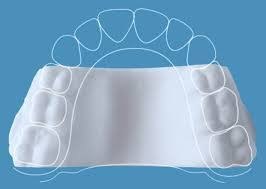
- Invisalign Palatal Expander. A series of 3D-printed expanders worn over several months, which widens the upper jaw in children of about seven to ten. Being printed to the child’s own scan, it avoids much of the bulk and the cleaning difficulty of older designs, which in practice is what decides whether a child actually wears it.
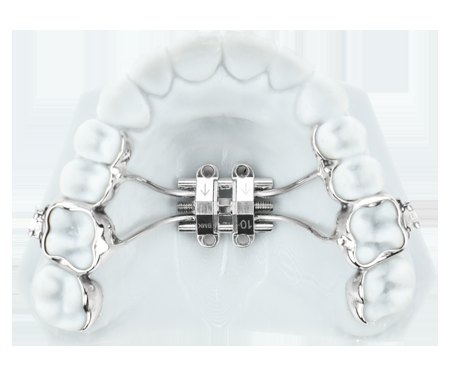
- 3D-printed fixed expanders. Cemented in place, so wear is not left to the child. Printing them from a scan removes the impression stage and lets the fit be shaped to the individual palate.
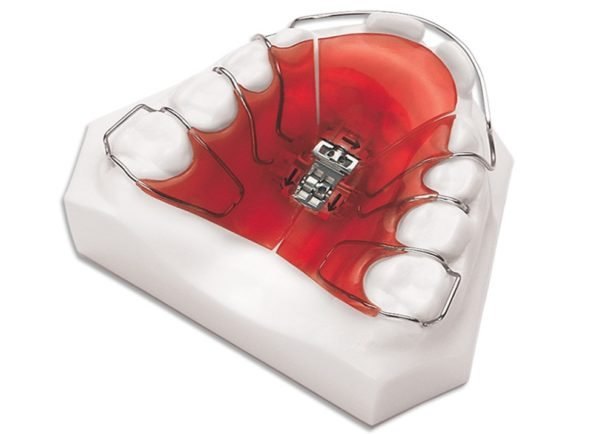
- Removable expansion appliances. A plate the child takes in and out, adjusted on a schedule. Suits cases where the amount of widening is modest, or where a fixed appliance would be difficult for the child to manage.
Guiding the lower jaw forward
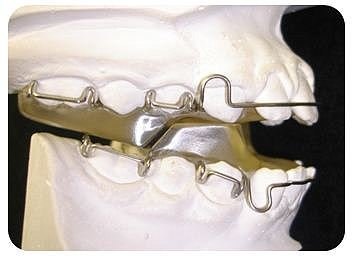
- Clark Twin Block. Two removable plates, upper and lower, that hold the lower jaw forward while the child grows, for a lower jaw that sits too far back. Worn as close to full-time as possible, including at meals, and adjusted as things move.
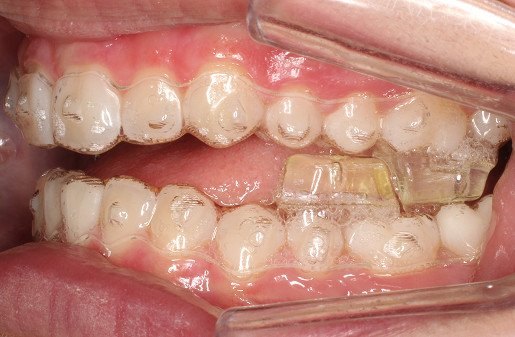
- Invisalign Mandibular Advancement. The same idea built into clear aligners, using precision wings rather than separate blocks, so the teeth are aligned at the same time as the jaw position is worked on. Most children find it easier to live with than a twin block.
The teeth themselves
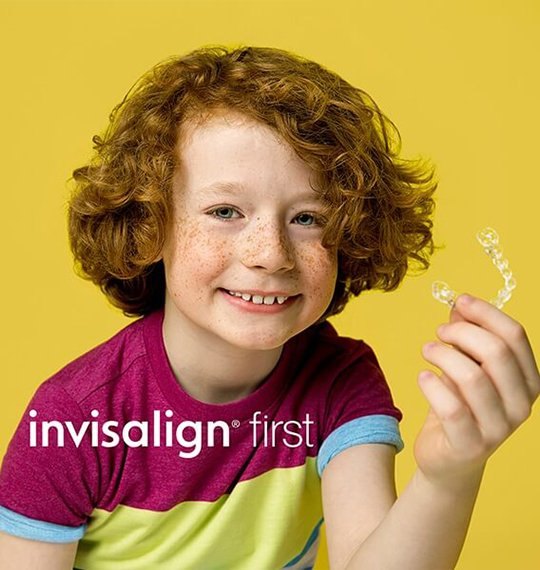
- Invisalign First. Clear aligners designed for a mixed dentition — roughly six to ten — where some adult teeth are through and some baby teeth are still in place. Worn 20 to 22 hours a day and changed every one to two weeks, for crowding, spacing and alignment while the jaws are still developing.
Two of these have a published fee — the palatal expander and the sagittal appliance, both on the fees page. The others are quoted in writing after the assessment, because what they cost depends on which appliance the case actually needs.
All of these depend on growth, which is the whole reason for treating at this age. Once a child is past puberty, guiding how the jaws grow is no longer on the table, and the same corrections need a different and larger kind of treatment.
Mouth breathing, snoring and narrow arches in children
Parents often ask about this, and it is worth separating two things that get run together. A narrow upper arch is treated here on its own orthodontic merits — it causes crossbites, crowding and an awkward bite, and the palatal suture is only open for widening while a child is still growing, so there is a real window for it. Widening the arch does also increase the volume of the nasal airway, which is simple anatomy.
What we are careful about is the next step in that reasoning. The evidence that expansion treats paediatric sleep apnoea is not strong enough for us to offer it on that basis, and this is an area with a lot of overclaiming. So if your child snores, breathes through the mouth during the day, sleeps restlessly or wakes unrefreshed, that deserves looking at properly in its own right, and we will refer you for an ENT and sleep assessment. Enlarged tonsils and adenoids are a common and very treatable cause, and that is an ENT question rather than a dental one.
Often both are worth doing: the arch is widened because the bite needs it, and the breathing is assessed because the breathing needs it. We will tell you which of the two we think we are treating. For adults, snoring and airway appliances are covered on our snoring and airway page.
Who does this at Calm Dental
Fees for this treatment are on our fees page, including GST. A written quotation follows examination.
Questions
What age should a child be assessed for early orthodontics?
About seven. By then the front adult teeth are coming through and the pattern of the bite is readable, while enough growth remains to use. Assessment at seven does not mean treatment at seven — often it means reviewing annually.
Does my child need an expander now, or can we wait?
It depends on what is being corrected. A crossbite or a genuinely narrow arch is easier to treat before the palatal suture fuses, so waiting has a real cost. Mild crowding often can wait. We will show you the records and explain which case yours is.
Will my child still need braces later?
Usually yes, in some form. Phase 1 creates space and corrects the jaw relationship; Phase 2 aligns the individual teeth once they are all through. Phase 1 often makes Phase 2 shorter and can avoid extracting adult teeth, but it rarely replaces it entirely. We would rather set that expectation at the start than at the end.
Does an expander hurt?
There is pressure and a feeling of tightness for a few minutes after each turn, and sometimes a dull ache on the first day or two. Children eat and speak normally within a week, though speech can sound different at first.
Will an expander help snoring or mouth breathing?
It may increase nasal airway volume, but the evidence is not strong enough for us to offer expansion as a treatment for snoring or sleep apnoea. If your child snores or mouth-breathes, we will refer you for a proper ENT assessment, which is the right investigation for it.
Who provides this at Calm Dental?
The dentists listed on this page. Complex skeletal cases are referred to an orthodontic specialist.