
Onlays vs Crowns: How to Tell Which One a Tooth Needs
Restorative dentistry · 26 August 2026 · 5 min read
An onlay covers only the damaged part of a tooth and bonds to what remains; a crown covers the entire tooth and is used where too little sound structure is left to bond to. Both can be designed, milled and fitted in one appointment at Millenia Walk on the CEREC system, usually in about two hours.
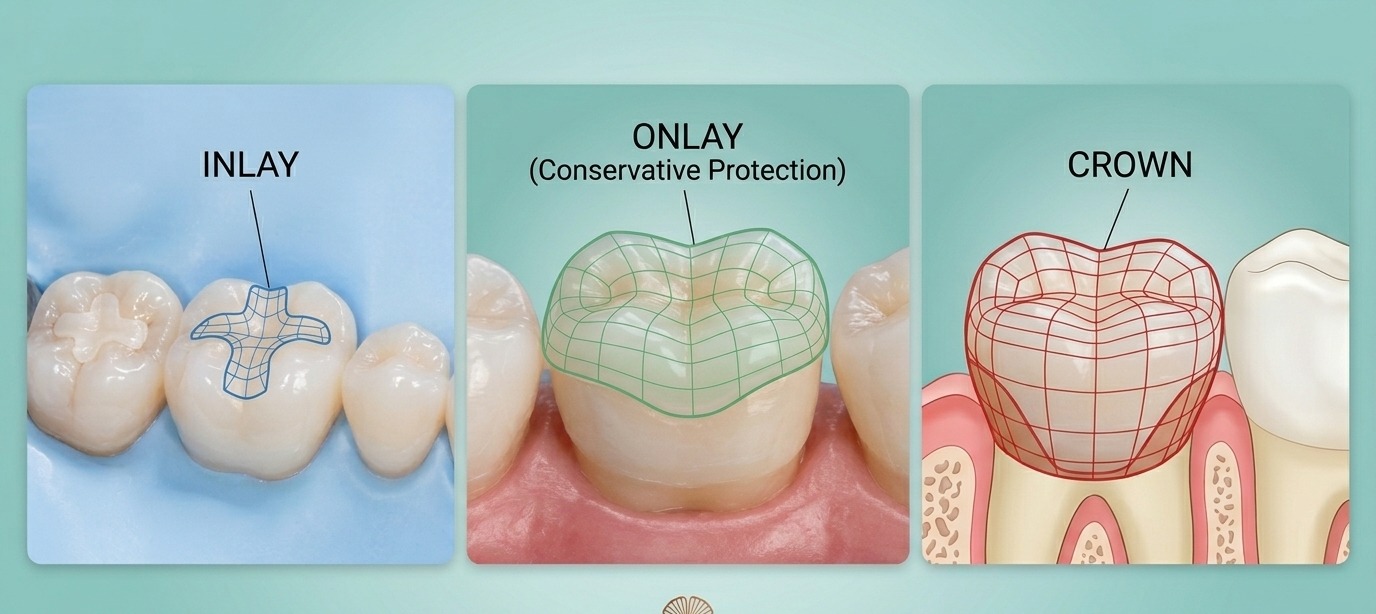
Two ways of repairing a broken-down tooth
A crown works by capping: the tooth is reduced all the way round so a cap can be cemented over the whole thing. An onlay works by bonding: the damaged part of the tooth is prepared, and ceramic is bonded directly to whatever sound structure is left, on top and around the sides where needed. Nothing is removed for the sake of the restoration itself — only what is already damaged.
The distinction matters mechanically, not just cosmetically. A bonded restoration that keeps a tooth’s outer walls distributes biting force closer to how a natural tooth does than a cap that has replaced those walls entirely.
When each is the right choice
An onlay is appropriate where enough sound tooth remains around the edges to bond to reliably — typically after a large filling has failed, a cusp has fractured, or an old amalgam filling is being replaced.
A crown is the better choice where a tooth is broken down on more than one side, badly cracked, or has had root canal treatment and lost significant structure as a result. In those cases there is not enough sound tooth left for bonding to be predictable, and a full-coverage restoration protects what remains.
The one-visit digital workflow
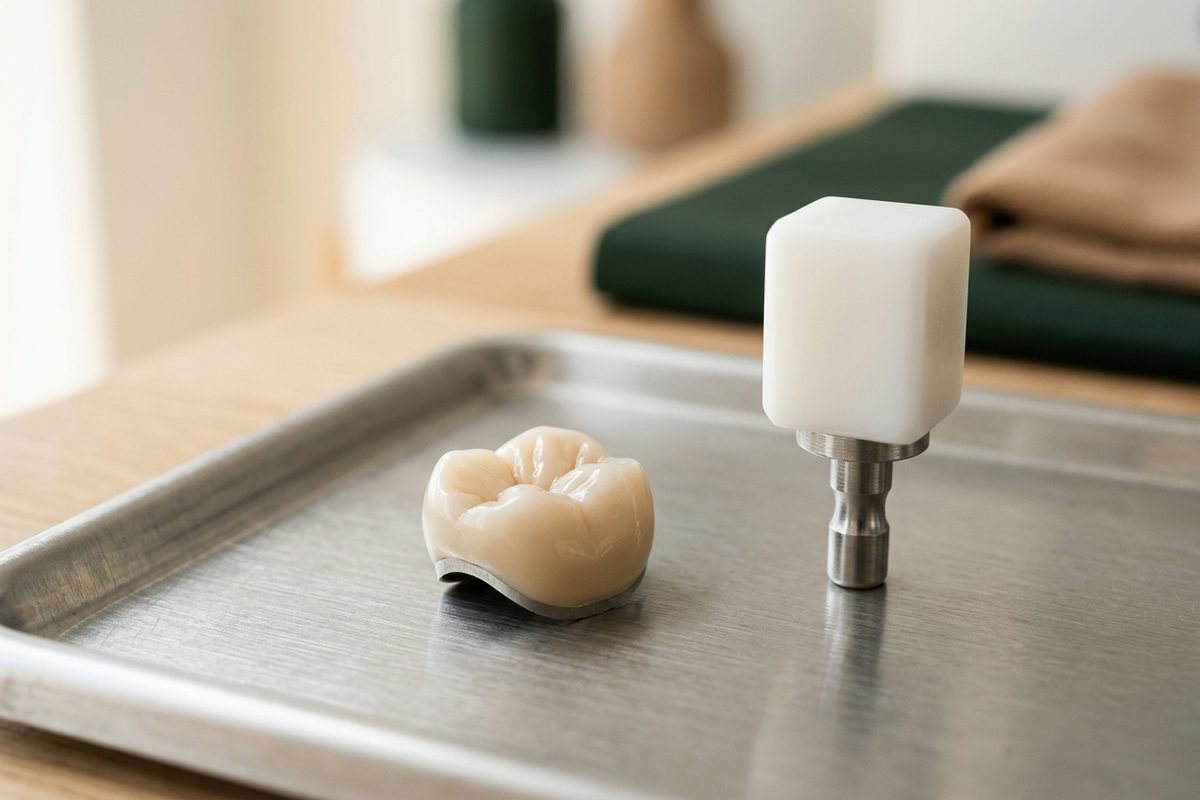
Both start the same way: a 3D scan of the tooth, with no impression putty. The restoration is then designed on screen and milled from a solid ceramic block in the clinic — CEREC MTL zirconia where strength under load matters most, or GC Initial LiSi Block and Ivoclar IPS e.max CAD lithium disilicate where translucency and shade matter more. It is tried in, adjusted and bonded in the same appointment, so there is no temporary restoration and no second visit for fitting.
Questions
What is the actual difference between an onlay and a crown?
A crown covers the entire tooth down to the gum line. An onlay covers and bonds to only the damaged part, leaving sound tooth structure in place. Where enough healthy tooth remains to bond to, an onlay removes less natural structure for a comparable result.
Can either really be done in one visit?
Yes, in most cases. The tooth is scanned, the ceramic is designed and milled on site, and the restoration is bonded in the same appointment — about two hours, with nothing temporary to wear home.
Is an onlay weaker than a crown?
Not in a tooth that suits one. A bonded ceramic onlay in a tooth with sound walls performs comparably to a crown. In a root-canal-treated tooth, a crown can be the stronger option.
How long does a bonded ceramic restoration last?
With good hygiene and a stable bite, well over ten years. What shortens that is untreated grinding, gum disease, or decay starting at the margin — all of which are checked at reviews.